Why Human Knowledge Still Matters in the AI Era

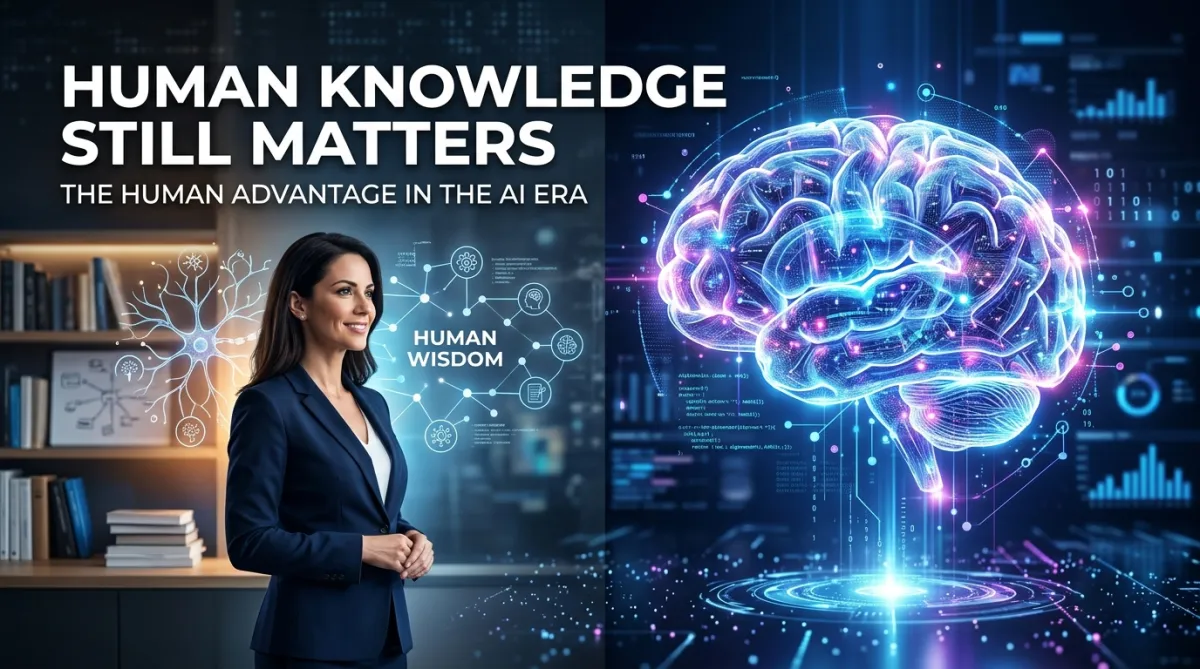
Artificial Intelligence is changing how we work, learn, create, and solve problems. From generating content to analyzing data in seconds, AI tools have become a part of everyday life. While these technologies offer incredible efficiency, many people are starting to ask an important question: if AI can do so much, does human knowledge still matter?
The answer is yes. AI is powerful, but it is not a replacement for human understanding, judgment, creativity, and experience. The most successful individuals and businesses in the AI era are not those who rely entirely on AI. Instead, they combine AI capabilities with human expertise to make better decisions and achieve stronger results.
Understanding the Difference Between Information and Knowledge
AI can process vast amounts of information, but information and knowledge are not the same thing.
Information consists of facts, data, and patterns. Knowledge comes from understanding, experience, critical thinking, and context. AI can provide answers based on existing data, but it does not truly understand the meaning behind those answers in the way humans do.
For example, AI can generate a marketing strategy, but an experienced marketer knows how customer emotions, market trends, and business goals influence real-world outcomes. That deeper understanding is what turns information into valuable knowledge.
Why Human Knowledge Remains Essential
Human Judgment Cannot Be Fully Automated
AI models generate responses based on patterns in data. However, many real-world situations require judgment calls that involve ethics, emotions, and uncertainty.
Business leaders, doctors, teachers, and policymakers often face decisions where there is no perfect answer. Human experience helps evaluate risks, understand consequences, and make choices that align with values and goals.
AI can support decision-making, but humans must remain responsible for the final judgment.
Context Matters More Than Ever
AI often struggles with context that goes beyond the data it was trained on. Human experts understand cultural differences, industry-specific challenges, and changing circumstances.
For instance, a content creator using a modern AI writing assistant may generate a draft quickly, but only a knowledgeable human can ensure the content reflects the brand voice, audience expectations, and current market conditions.
This is why AI-generated content still requires human review and refinement.
Creativity Is More Than Pattern Recognition
AI can create images, write articles, and generate ideas. However, genuine creativity often comes from personal experiences, emotions, curiosity, and unique perspectives.
Many groundbreaking innovations happen because people challenge existing assumptions and think beyond available data. Human creativity is not limited to patterns from the past. It can imagine entirely new possibilities.
AI can accelerate the creative process, but human imagination remains the driving force behind meaningful innovation.
The Growing Importance of Critical Thinking
As AI-generated content becomes more common, critical thinking becomes increasingly valuable.
Not every AI response is accurate. AI systems can produce outdated information, misunderstand context, or generate convincing but incorrect answers. This phenomenon is often referred to as an AI hallucination.
People who possess strong research and analytical skills can identify errors and verify facts. For example, when researching online trends, using a reliable keyword research tool can help validate search demand and uncover opportunities rather than relying solely on AI-generated assumptions.
Similarly, content creators often benefit from checking readability and structure with a professional word counter tool to ensure quality and clarity.
The ability to evaluate information critically will become one of the most important skills in the future workforce.
AI Works Best as a Human Partner
The most productive approach is not choosing between AI and human knowledge. It is combining both.
AI can:
- Automate repetitive tasks
- Process large datasets quickly
- Generate first drafts
- Identify patterns and trends
- Improve operational efficiency
Humans can:
- Apply judgment
- Understand context
- Solve complex problems
- Build relationships
- Make ethical decisions
- Drive innovation
When used together, AI and human expertise create better outcomes than either could achieve alone.
For example, SEO professionals can use an SEO meta tag generator to streamline optimization tasks while still relying on their expertise to develop a comprehensive search strategy.
Lifelong Learning Is the New Competitive Advantage
The AI era does not reduce the value of learning. In fact, it increases it.
People who continuously develop their skills are better equipped to use AI effectively. Understanding your industry, customers, and business processes allows you to ask better questions and evaluate AI-generated outputs more accurately.
According to World Economic Forum research, analytical thinking, creativity, resilience, and lifelong learning are among the most important skills for the future workforce.
Likewise, guidance from Google Search Central continues to emphasize creating helpful, people-first content rather than content produced solely for search engines.
The individuals who thrive in the coming years will be those who combine technology skills with strong human knowledge and adaptability.
Building Human Skills That AI Cannot Replace
Communication
Clear communication helps teams collaborate, solve problems, and build trust. While AI can assist with drafting messages, meaningful communication requires empathy and understanding.
Emotional Intelligence
Understanding emotions, motivations, and relationships is a uniquely human strength. Emotional intelligence plays a critical role in leadership, customer service, education, and teamwork.
Problem Solving
Complex challenges often require creative thinking and the ability to navigate uncertainty. Human problem-solving goes beyond finding existing answers and involves creating new solutions.
Ethical Decision-Making
As AI becomes more influential, ethical considerations become increasingly important. Humans must determine how technology should be used responsibly and fairly.
Frequently Asked Questions
Does AI make human knowledge less important?
No. AI increases the value of human knowledge because people still need to interpret, evaluate, and apply AI-generated information effectively.
Can AI replace experts in professional fields?
No. AI can assist experts, but it cannot fully replace professional judgment, experience, ethics, and contextual understanding.
What skills are most valuable in the AI era?
Critical thinking, communication, creativity, emotional intelligence, adaptability, and problem-solving are among the most valuable skills.
Why is critical thinking important when using AI?
Critical thinking helps identify errors, verify information, and make informed decisions instead of accepting AI outputs without question.
How can businesses benefit from AI without losing human expertise?
Businesses should use AI to automate routine tasks while allowing employees to focus on strategy, innovation, customer relationships, and decision-making.
Will learning still matter if AI becomes more advanced?
Yes. Learning remains essential because human understanding is required to guide AI, interpret results, and solve real-world problems.
Conclusion
AI is transforming the world at an unprecedented pace, but human knowledge remains the foundation of meaningful progress. Technology can process information and automate tasks, yet it cannot replace human judgment, creativity, emotional intelligence, and ethical reasoning.
The future belongs to people who learn how to work with AI rather than compete against it. By combining technological tools with deep human understanding, individuals and organizations can make smarter decisions, create greater value, and adapt to an increasingly digital world.
As AI continues to evolve, investing in your knowledge, skills, and critical thinking abilities will remain one of the smartest decisions you can make.
Also Read : Common Tech Myths That Are Still Believed in 2026